I have recently been watching Brilliant Minds with my mom and grandmother. I love this show because it is all about solving medical mysteries, and the protagonist, Dr. Wolf, is a unique, brilliant doctor who does everything he can to understand and help his patients (what I would give to have a doctor like this in real life!). Dr. Wolf has a history of trauma and lives with a disease that prevents him from recognizing faces called prosopagnosia or Face Blindness. He also struggles with not being “a normal” person, and he has various coping methods that keep him sane and productive as a doctor.
The show is heart-wrenching and beautiful at the same time. I can’t help but be inspired that even though Dr. Wolf is fictional, he doesn’t let his personal or professional challenges prevent him from living his life and making a positive difference in the world. And I truly believe that his coping methods of swimming in the Hudson River, coaxing dead plants to life, and having a verified greenhouse in his house allow him to do that.
Throughout the years, I’ve faced some extreme challenges and struggled through serious, life-threatening depression. Some of my coping mechanisms have been healthy (like Dr. Wolf’s), while others have definitely not fallen into that category. I’ve discovered that I tend to fall into unhealthy/risky coping mechanisms when I can’t seem to think of something more positive to engage in that will actually make me feel better. This post will provide ideas that you and I can both fall back upon when we’re really struggling with depression or just can’t seem to escape the hamster wheel our brain is running on.
COPING METHODS ARE BAD (just kidding)
We often think of coping methods as being something bad, but in reality, they enable most of us to survive. Many times, the assumption is that people who are “coping” will cope in negative ways like drugs, alcohol, sex, gambling…which all tend to turn into addictions that make people’s lives even worse than they were before. While coping methods can turn into addictions (another topic for another post), they certainly don’t have to.
When we can’t manage our life, or the situations that we find ourselves in, or if we struggle with past trauma that we haven’t worked through, humanity’s initial, tried-and-true behavior tends to follow a cycle: grasp for anything that makes them feel better….ignore the real problems that are facing them….fall into confusion/delusion when they face the consequences of whatever coping methods they chose….and then cope again to make up for feeling bad from the original coping method and so on.
We see it all the time in the people around us and in ourselves.
We all want love and acceptance. And none of us wants pain, whether it is physical, mental, or emotional. There is nothing wrong with that, and it is perfectly human and absolutely normal to try to deal with these situations in whatever way we can. It is how we try to get relief that either helps us or causes the problems that cause more problems.
EXAMPLES OF COPING METHODS
“Unhealthy” Ones:
- Social Isolation
- Emotional Eating
- Self Harm
- Overworking
- Avoidance
- Substance Abuse
- Spending Money (Unnecessarily)
“Healthier” Ones:
- Mindfulness
- Journaling
- Practicing Gratitude
- Art/Creative Expression
- Social Support
- Exercise
- Watching TV/Reading Stories
Coping mechanisms can be healthy and helpful or unhealthy and unhelpful, but they all succeed in making us feel better temporarily. They are natural ways we gravitate towards when life is pummeling us, or when we are feeling depressed, or when we are unhappy with where we are in life. Coping mechanisms are the methods we’ve discovered to help us function even when we are falling apart inside. Human beings can’t live in pain and sadness and misery for long before they try things that will ease their suffering.
HOW I’VE COPED IN THE PAST
During my teen years and early to mid-20s, when I was dealing with my Dad leaving and being trapped in an abusive relationship (among other things), I didn’t necessarily understand why I felt so awful. I mainly thought it was a result of my sinfulness. I didn’t understand or recognize that a lot of my behavior resulted from simply trying to control something in my life. Busyness and overworking, lack of sleep, anorexia, running away from my life by traveling, and avoidance of all negative thoughts and feelings were chronic coping mechanisms of mine. Faith, exercise, journaling, fur babies, relationships, and obsessive cleaning were other methods that were maybe healthier but still enabled me to not think about the things that I really needed to process through.
In my early 30s, I began recognizing that I needed help. Therapy and medication were introduced. Dancing was my passion, career, and crutch all in one. Retail therapy became a thing. Even more, I refused to think about or remember any of the painful things that had happened or the people and pets I loved who had died. All of these coping methods were super helpful in avoiding what was happening in my life (such as my dad, my cat, and my grandmother dying in the span of a few months, my diagnosis with Ehlers-Danlos Syndrome, etc.)
In my mid to late 30s, my depression became all-consuming. Many of the ways I had coped before didn’t work anymore. I couldn’t exercise because of my health condition. I had no drive to write or lose myself in books. I didn’t have a faith or a church that I belonged to. I had more and more therapy and medication, but they didn’t seem to help either. Sex, retail therapy, and my cats seemed to be the only things I could find any tiny measure of very brief pleasure or respite from.
CONSEQUENCES
There were the short-term consequences of my coping mechanisms, like … feeling physically worse because I didn’t let myself sleep the night before (because I was afraid of nightmares), multiple injuries from dancing 30-40 hours a week, and not being productive because I was playing with the cat nonstop. But there were long-term ones as well, such as enormous medical and mental health bills, and strain on my marriage, which then resulted in a divorce, etc. And those consequences just made me hurt worse, which made me try to find anything else that would just make me feel better, even if it was for a few moments.
Unfortunately, because I used both my healthy and unhealthy coping mechanisms to avoid whatever pain I was experiencing, I actually just made things worse. My body started responding in its own way to cope… I’ve had panic attacks, dissociative seizures, migraines, insomnia, and physical pain. At my most depressed, I isolate, shut down, and stop eating. I’m not purposely trying to do those things; they just seem a natural progression of what happens when I go on autopilot because I’m hurting too much. My biggest consequences have been the disintegration and dissolution of my marriage and my attempt at taking my own life last year.
THINGS I’VE LEARNED SINCE
It really wasn’t until I started seeing my old therapist, Jon, in PHP that I started understanding my behavior. He pointed out that our goals in life tend to be “feel better” and “be happy,” when our goal should be more to “understand self better.”
What in our lives makes us believe and think the way that we do?
How has trauma shaped us?
Why do we act the way that we do?
What makes me feel better in the moment, and why does it have that effect on me?
Do I have to fall into the same patterns, the same choices, the same coping methods (especially if they are making things worse!)?
The answer is no. At the end of the day, we still get to choose how we are going to cope.
KUNG FU PANDA THOUGHTS
I used to think of my old therapist, Jon, as Kung Fu Panda. He was always just so wise and zen and funny, too.
He used to say, “The past is gone. The future is uncertain. The present is a gift, which is why we call it a present,” which I think he borrowed from Deepak Chopra. He’d use this to segue into Reality Therapy and Choice Theory, which recognized that we all have needs that need to be met, we all have choices in how we meet those needs, and whether we want to or not, we all bear responsibility and accountability for those choices. The idea is to “limit harm” both to ourselves and to others and the world around us. This is undoubtedly not a very popular theory in our current culture, but it makes so much sense to me.
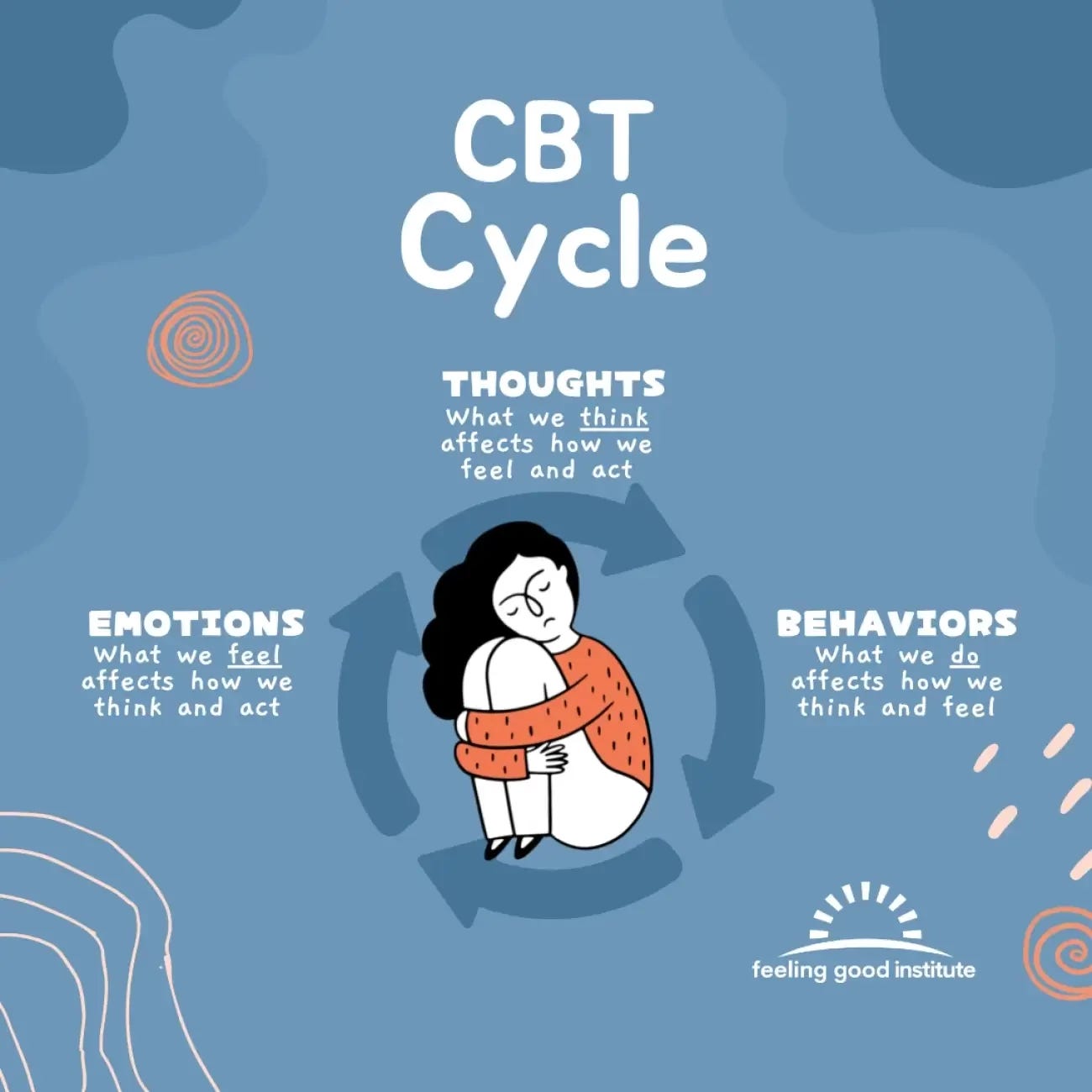
I would ask Jon how I could not be so overwhelmed with sadness and grief, and how I could manage the stress in my life that was paralyzing me. He would point me back to the CBT circle over and over again – my thoughts affected the way that I felt, which led to my behaviors, which shaped my thoughts, and so on. If I wanted to change the way that I behaved (being paralyzed), I had to change the way that I felt (sad/defeated), which meant I had to change the way that I thought about stress.
“Stress is any force acting upon an object, Rachel. For you, it’s your divorce, your living situation, your health, your financial situation, your job, or inability to hold a job, etc.”
He would go on to say that it’s only natural that we resist things that are painful and hard and unpleasant. But the more you resist, the more stress will affect you. The more you try to force reality to change, the more frustrated and upset and stressed you become. Stress is what triggers your feelings of lack of control.
“Well, what am I supposed to do? Just accept things the way they are? How do I DO that??” I’d respond.
Jon would chuckle. “No matter what we do, bad things happen. Some days are good and some are bad. When you realize this, just accept it, maintain your balance. Don’t necessarily fight it. Of course, we should look for other options if we don’t have any. We should make changes where changes need to be met.
“But remember, nothing stays permanent. Some days are just out of our control. We can’t prevent this, but we can work on not giving in to the present crisis. Overwhelming circumstances are beyond our control. So, release the hold you have on those things. Focus on what you can control.”
This is changing my life (when I remember it!). I need to practice this every day because, unfortunately, I don’t just easily “get it” and then transform into Kung Fu Panda Jon. It’s hard, intentional work.
I HAVE COME A LONG WAY
In the past, I have responded to stress and to the things outside of my control with unhealthy, unhelpful coping mechanisms. These enabled me to ignore what was happening to me, to shove it somewhere I didn’t have to deal with it. But then, my body took over and I lost my ever flipping mind.
I am not an anomaly.
I have an evolving plan now in place. Even though I can’t control the things that happen to me (like losing my job last week), I can control how I cope with them. If I were brilliant like Dr. Wolf from that show I mentioned earlier, maybe I’d nurture a jungle of plants in my living room or dive into the nearest river to “clear my head.” You have to find what works for you, though.
I can’t go for runs anymore or dance, but I can still go for long walks some days. Cleaning my house is some of the best mind-numbing medicine I have found, so long as it doesn’t kill me afterwards. Watching cute animal videos is like taking crack. Staying busy and being with loved ones are great distractors too, so long as I still make time to process my feelings and thoughts about what is happening to me.
Being aware of triggers and knowing that I am going to need to cope with some things is the first line of defense. Remembering that I can choose how I respond to the things outside of my control helps me then be more intentional about picking healthier coping methods. I would love to hear what coping methods you use to make it through!
FINALLY
I am attaching a Coping Methods Packet here, which I compiled from a few sources. I am hoping it can be helpful in identifying what coping methods you’ve used in the past (the “good” and the “bad” ones) as well as how you can cope in the future with stress.
I am choosing to remember this today: “Pain is inevitable, but suffering is optional.” A Japanese writer named Haruki Murakami said this, but it is something I think Kung Fu Panda Rachel can say too.
Keep on keeping on, friends! How can you Kung Fu Panda your way through today?