
“NORMAL” OR COMMON PAIN
Any kind of pain is unpleasant – breaking a bone, getting a cut, having an infection, dislocating a joint, getting burned…
headaches, body aches, ear aches, toothaches…
pulled muscles, papercuts, split toenails, hangnails, sunburn, UTIs, frostbite, whiplash, appendicitis, kidney stones, even acne etc.
Anything that happens to your body that is outside of its homeostasis-it’s search for the right balance so that all your bodily functions can work – typically hurts.
Most of these hurts are acute and don’t last very long (thank goodness!). We can treat them with analgesics and corticosteroids and NASIDs and Band-Aids and surgery and aloe vera and antibiotics and they may disrupt our life, but there is an end in sight. A light signaling healing once you reach it. You can know that in a few days, weeks….you will feel better and be able to do all the things you were doing once before.
Obviously, there are other conditions that cause pain that are more serious and can take longer to heal, like pneumonia, shingles, pancreatitis, endometriosis and some cancer (cancer is very complicated and I am in no way minimizing it here—just using it in a very broad sense).
The point is, these conditions don’t just get better right away and they can cause months if not years of pain. But there are cures to be had and possibilities for hope so even if the light at the end of the tunnel seems a long way off, you still know that you can hopefully reach it.
It is not impossible that you will still be able to get your life back.
CHRONIC PAIN
There is something different about chronic hurts (not worse – I am not trying to glibly compare the two – just different).
Things like diabetes, rheumatoid arthritis, cerebral palsy, Ehlers-Danlos Syndrome (EDS), Crohn’s Disease, Raynaud’s, multiple sclerosis (MS), fibromyalgia, lupus, Lyme Disease, etc. cause pain that is chronic and/or constant.
The type of pain that never goes away.
Psychologically – at least for me – you have to approach and respond to this kind of pain differently than you do a shit-hurts-but-I’ll-get-over-it-pain. People who have these conditions have to face the fact that they will never be “well.” There is no cure, no end in sight, no psychological bolstering we can do like “I just need to hold on long enough.” There is no pill or procedure or experiment or habit that we can experience or change that will fix us. Our bodies are forever like this and all we can do is try to manage the pain (and other symptoms) that they bring with them.
It is its own hard pill to swallow.
And for whatever reason, people who seem to have these autoimmune or genetic diseases (where your body literally fucking hates you), never seem to just have one disease.
It’s like a curse, that we inevitably collect diseases like baseball cards.
All the….stuff…. that comes with these diseases are lousy. The endless doctor appointments, the constant pharmacy runs, the scheduling difficulties with your job and your family and your body, the begging for disability status, the fatigue that weighs down on you like a freight train, the losses that accumulate in things you can no longer do, the constant fighting you have to do against the system just in order to survive, the bickering you have to do with loved ones who don’t understand your illness(es), etc. It is exhausting.
But to me at least, the hardest part is just dealing with the actual physical pain.
REALITY OF PAIN
I live in pain.
Most of the time though, it hums in the background. If you want to use the stupid number chart, I’d say I most often hover between a 2.5 and a 4. The pain is there, but I’m so used to it, I’ve learned to function with it. I’m still able to do most things, though I do tire quicker than everyone else, I have to take more naps, and I avoid things that I know are going to make the pain worse. It used to be “ok, no more ultimate frisbee or hiking up a mountain or dancing at a performance” but now it’s “ok, I’m not going to pick up that stick in the yard” and “yep, doing that simple yoga pose is a no-go” and “nope, I can’t run after you, dog.”
I used to have episodes that would last anywhere between an afternoon and a month where my pain levels just escalated to a point where I could barely function, if at all. Those episodes were pretty far between.
Now, unfortunately, I have them much more frequently.
In these “episodes”,” pain sits sits at a level 6-7, sometimes 8. If the 8 is bordering on 9, I go to the ER. Or if something weird is hurting that I can’t explain away due to joint instability or subluxations (partial dislocations), I go to the ER.
December was a bad body month for me, and January is proving to be even worse.
I’m not going to lie…when I have a bad body day, I usually just accept it, hunker down, and hope that tomorrow will be better. But when I have a bad body…month(s), it gets a lot, lot harder. It is a huge source of my depression to be honest. I begin to have less stamina during the day, less hope for tomorrow, more sorrow for what I couldn’t do today. I become more emotional, more grumpy (though thankfully, I don’t take it out on others – I try really, really hard not to anyway), I cuss a lot more, I have less patience with stupid.
I feel like I have less and less energy reserves to fight whatever my body is fighting and I feel trapped in a shell that I just long to escape from.
This week I’ve been at a solid 7 and a couple days an 8. I almost went to the ER one evening but I pushed myself through because I hate going so much. And honestly, I have a shit ton of trauma from the dozens of other ERs I’ve been to so that part of my PTSD flares up.
What do I do on these days? How do I make it through the haze of debilitating pain without giving up since I know I will always face this and it will most likely only get worse?
PAIN MANAGEMENT
I have lots of tried and true pain management techniques.
Notice I say “management” and not obliteration techniques. On the good days, this means that my techniques help me so I can still clean the house, play with my cat, dog train, cook dinner, go on a walk, attend to my legal and medical battles, write, etc. On the bad days, it means surviving to the next day with my soul and integrity still in tact.
I have both philosophical techniques and practical ones, which I will share here.
- Understand your pain and recognize it for what it is. There are different types of pain and I think when you live with it all the time, it becomes easier to identify what is really going on, which then helps you pick and choose what tools, medications and modalities you need to use to attack it. We essentially become pain experts, haha!
- As a general rule, if pain is a burning sensation, it probably is nerve related. If you have spasms, it’s muscular (for me, spasms can be anything from feeling like a cheese grater is eating through my muscles or a butter knife is stabbing and twisting under my ribs or a complete lockdown in which I can’t move something at all). If I feel like something is slipping or buckling, it’s one of my bones or joints subluxating. If it’s a dull ache, it might be inflammation. (Anything deep and sharp in your abdomen is in its own category.)
I then have to think about how much does it hurt. For me, anything under a 4 does not warrant medication. A 4-6 will warrant “regular meds” like Tylenol or ibuprofen but anything above a 7, I will probably have to take something stronger. If I know it’s muscle related, I take a muscle relaxer. Pain around an 8.5 I’ll go to the ER for. A 9, I’ll call an ambulance for. A 1o, I’ll assume I’m dead or on the brink of dead.
But then I also have to consider my distress levels due to the pain. These are less straight-forward and make things more complicated. If I have a low distress level, I’m still able to function and do pretty much everything I need to do. If I have a medium stress level, I’m going to have to start cutting things out and just focus on treating the pain. If I have a high distress level, I am barely able to function and all I can think about is the pain.
I don’t ever want to reach the high distress level unless I have to, because that means I’m missing work, my house is becoming a pigsty, we’re eating less healthy meals, I’m missing out on relationships, my anxiety and depression start really kicking in, etc.
Other questions to consider: How long has the pain lasted? Is the pain isolated to one body part or is it all over? How much is it taking over my thinking? These all affect distress levels and maybe warrant taking heavier meds earlier than I would usually or treating the pain more aggressively than normal so that I don’t fall into that high distress category.
- Accept the pain and the loss. This sounds really simple, but it is the hardest thing for me to do. I don’t want to accept that my body won’t let me sit up and write. I don’t want to accept that my body won’t let me bend or pick up anything that day, so all my grand aspirations of cleaning house go out the window. I don’t want to accept that life is just harder for me and I can’t do everything else every one else does. But I have learned that throwing temper tantrums doesn’t change anything and resisting reality just makes things worse. It increases my anger and self-hatred and self-pity and depression. I have to consciously, “radically” accept where I’m at physically each separate day and sometimes multiple times during the day. (I wrote a post on radical acceptance here.) Sometimes I can’t just bluster, muster through. Sometimes the pain is going to get the better of me, and that’s ok too. There is SO much I can say about acceptance versus resistance, and I will at a later date.
- Choose who to share your pain with. Some people complain about their ailments all the time and they let you know exactly how they’re feeling and they even use their pain and illnesses to take advantage of you. No one likes these people very much (or it’s really hard to choose to love them) and I have always been terrified of becoming “that person.” So, most of my life, I’ve gone the opposite direction. I have learned to mask my pain. Even when I was 5 years old and knocked a tooth out root and all, I refused to cry when the emergency dental intern pushed that tooth back into my gum without anesthesia. I have learned not to react to pain, not to admit to pain. I make light of my pain, and I hide my pain. I always put on a strong exterior. Part of it is that I don’t want doctors to think that I am making things up or that I am exaggerating my symptoms (which comes from a lifetime of being told I couldn’t be hurting as bad as I say I am because they can’t find anything wrong with me).
3. But honestly my stoicism hasn’t been helpful at all, because it probably is really hard for someone to believe that you are in excruciating pain if you’re smiling when you say it. I have learned to be more forthright and more honest about my pain with medical professionals and I insist more in making sure they understand how the pain is affecting me. I let myself gasp or groan or jump or crumple or cry even - if that’s what my body is naturally doing. It helps them (and others) understand better how bad it is.
4.I am learning to be more open about my pain with close friends and family too. Not everyone! I don’t want everyone to know how I am really feeling, and honestly most people cannot begin to understand.
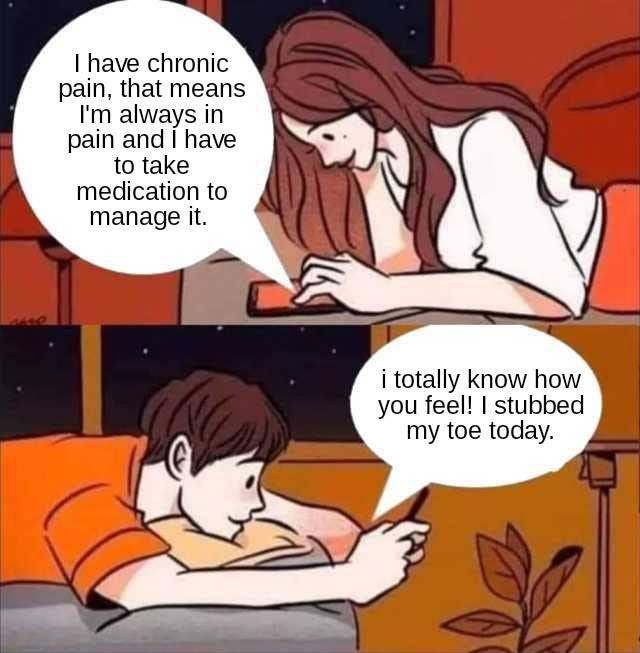
5. But I have found with my close network of loved ones that I don’t need to hide what’s really going on anymore. They would rather know how I’m hurting so that they can offer comfort and help. This is still really hard for me to understand - that people want to walk with me through the pain because they love me. They aren’t going to stop loving me because of my pain and illness (which I think was a subconscious thought I had for decades). By being dishonest with them, by masking how I feel, I am denying them the chance to be there for me in my time of need.
- One of my other very conscious fears is that my pain and illness will be a burden on my loved ones. But as of yet, almost none of my loved ones have said that I am “too much” for them or that I am burdening them (and the only one who has I am now divorced from). It is hard for me to believe that I am not a burden though, and I do really struggle with the insecurity of wondering when my pain will be too much for people to handle. Hence, why it is still really hard for me to be open about my pain and my gut reaction is always to downplay it. I’m working on this though!
- Be grateful for the good days and the good moments. They might feel like they are few and far between and like they may never come back again. But they will. That doesn’t mean those days will be pain free. It just means I will be in a better place to accept where I am and I will have a brighter perspective. It means that despite the pain, I can still enjoy the beauty of being in nature, the chance to play a game of Blockus with my cousin, the opportunity to celebrate birthdays with my nieces, plant flowers in my grandmother’s memory, fall head-on into a good book, have coffee with a friend, enjoy a glass of wine, and so many more wonderful moments.
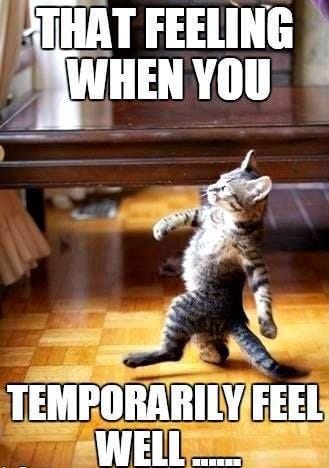
6. Maintain a sense of humor. You’ve just gotta. I have nothing really more to add to this.
For the sake of not letting this get too long, the next post will be on how I manage my pain - the practical techniques I use - including notes on medications, heat therapy, mindfulness, bracing/wrapping/splints, procedures, physical therapy and other tools.
Keep on keeping on, friends.